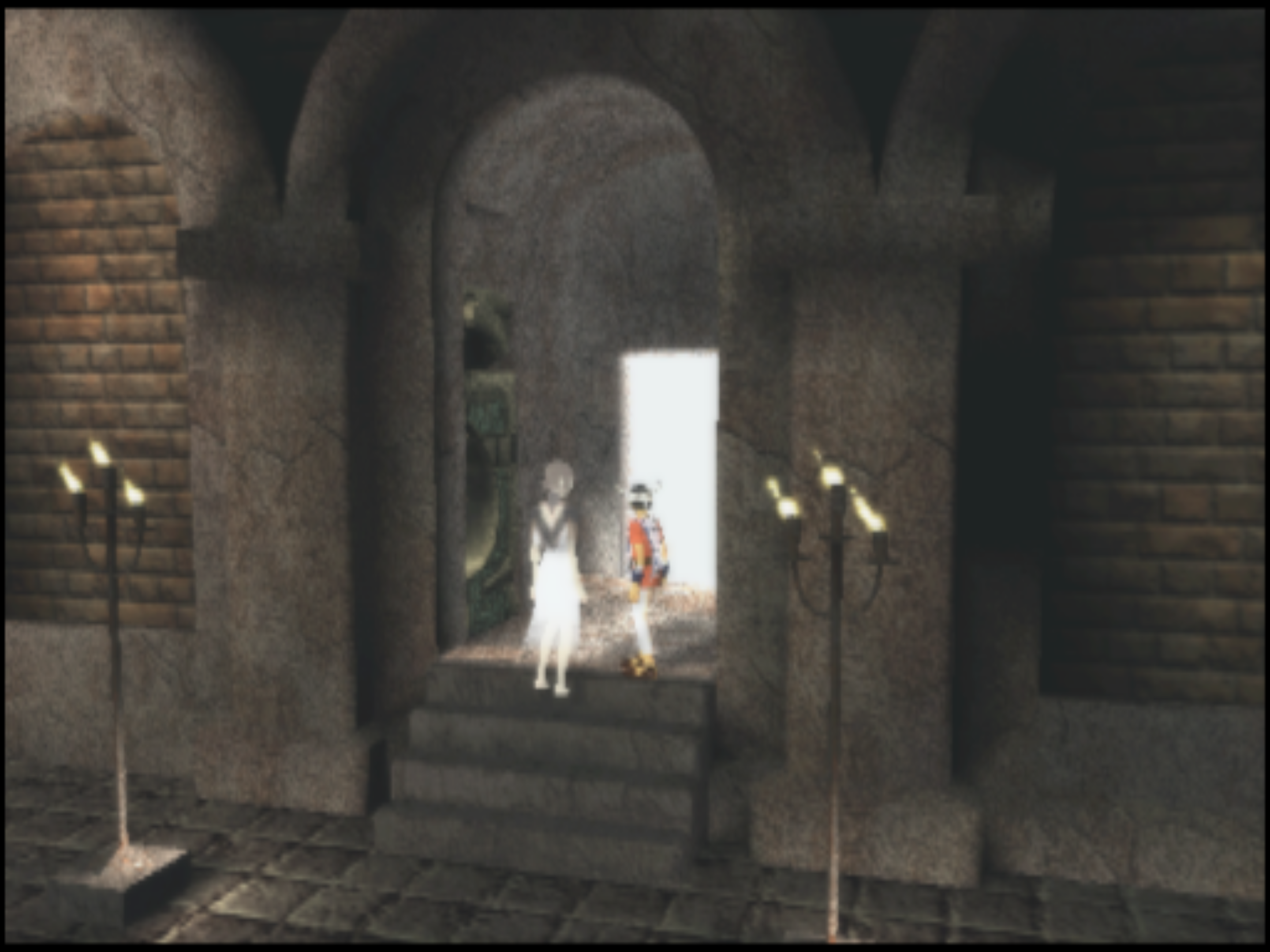
Computer games are tricky. They are a multi-modal expression of interactivity that are uniquely bound to the technical limitations they are made within. Just as a game exists as its ambitions, intentions, and perceptions, it is equally defined by its limitations. The craft harnessed to work within those limitations is valuable, even when the creator detests what they see as only an approximation of their vision. In computer games, the constraints of software and hardware are part of the work. Relaxing those constraints in a reissue can be beneficial to the play experience, but can also diminish the value of its creation. Controls, simulations, animation systems, texture sizes, frame pacing; it's my view that these cannot be fully separated from the "artistic" qualities: mechanics, game design, art direction, writing, acting, etc.
Touching the Veil
The controller is the medium through which interaction happens, allowing these elements to come together to form an interactive computer game. How the intentions of the player are able to be expressed through the controller is another aspect of the work, as are how the controller limits or permits those expressions through its physical design. It follows then that the player and developer are co-authors of the work through the interactive layer. The developer maintains supremacy by setting the rules, but players equally bring their desires to the interaction, including those that weren't considered by the developer. The limits of controllers and computing power creates the veil that casts this interplay, and informs what is possible when developer and player meet.
Most games are eventually freed from their limitations through time. Ports to newer systems, emulation enhancements, mods; these allow games to be enjoyed at higher resolutions and frame rates, or controlled with more precise or forgiving controllers. Such gains are often described as approaching "what the developer intended", an idea that I reject. Removing limitations only alters what is still a work derived from constrained tools; the intention of the developer is no more tangible in play.
For example, the great PC port of Jak & Daxter by the OpenGOAL project loads very quickly on my SSD drive, which is nice. But Jak 1 does not have many loading screens, because its levels were designed to account for the PlayStation 2's ability to stream assets. This was an innovative solution at the time, but we can see that playing on modern hardware cannot change the fact that it was created in the crucible of 6th-gen game development and limited by what the lasers of DVD drives could allow. Had the developers access to NVMe data speeds in 2001, Jak 1 would probably have been a very different game. To approximate that difference in some hypothetical future remake would be to change the game fundamentally. Regardless of our opinion of such a thing, it would be something new, open to critique or praise, but not supplanting the original work.
This example is not axiomatic, I'm just trying to convey a need for a plurality of readings in this age of remakes. A dance between contemporaneous and retrospective analysis. Such an approach may improve the discussion around games needing retroactively "fixed" or having "aged poorly". Reissues or mods that add so-called "quality-of-life" changes ought not to be seen as "the only way to play" upon release. This issue is sensitive to the age of the work. Games released in the last decade are allowed a more contemporaneous reading for longer, due mostly to the relative slow-down of hardware advancement. Death Stranding, while worth discussing the merits of its original PlayStation 4 release, can still be discussed mostly the same when played via its Director's Cut release on a high-spec PC.
"Will This Run On My 2080Ti?"
Time's effects eventually come for every game, even those we today consider triumphs of the technical arts. A great benefit of the PC platform is its ability to bring older games along for the ride, naturally supporting greater fidelity as hardware improves. But this can also collapse context, making some merits less obvious. Such is the case for games built in Valve's Source engine. Originally debuted in Half-Life 2, the leap in graphics and its unique physics simulation made it the Crysis of its time. Today though, Source games are the minimum benchmark for any potato-powered machine. That these games are widely playable at a good performance level is obviously a good thing, but its worth observing how the perceptions of their technical merits (which informed the possible designs) have flipped over time.
The risk of this historical context collapse then is that eventually, given enough technical advancement, older games won't make sense to new players. The technical limitations they operated in will be obscured by a decade or two of 16X Anisotropic Filtering and 144Hz monitors, leading to the death knell remark for any ludological analysis: "this game hasn't aged well". Remasters and remakes can stave off this fate for but a moment, but only quicken this result in the long-term. Will Crash N.Sane Trilogy appear all that remarkable in a decades time? Has its memory already started to decay? How will anyone care for the craftsmanship of Shadow of the Colossus (2005) when Sony will only sell you Shadow of the Colossus (2018)? The latter in retrospect will appear much like all the other 30FPS, 1080p, PlayStation 4 games of its time. Indeed it wouldn't be obvious to new players that its follow-up, The Last Guardian (2016), stood on the shoulders of immense innovation and artistry achieved over a decade prior.
You've Played The Game
The context collapse of games as a software artform has lead us to casual talk of replacement. Resident Evil (1996) is often viewed as a novel antique of a different time, with Resident Evil (2001) considered to be a more than suitable substitute. This notion disturbs me, not just because they have totally different art styles, but because it allows the original work to begin to fade away in our collective memories. In other mediums, a work such as Resident Evil (1996) would be de-facto canon, Computer Gaming 101.
Similarly, saying Metroid: Zero Mission is the best way to experience Metroid is nonsensical. They are different things, related, but different. You can't cherry-pick this, Resident Evil 4 (2023) is not Resident Evil 4 (2005). They can both be appreciated but must be considered a work of a specific time, place, culture and taste. Resident Evil 4 (2005) is the culmination of Resident Evil (1995), Resident Evil 2 (1997), Devil May Cry, Doom, Raiders of the Lost Ark, and the Holy Roman Empire. A cacophony of influence that gave us an entirely new style of action game. Resident Evil 4 (2023) is the culmination of Capcom's quarterly earnings, Resident Evil 4 (2005)... and The Last of Us.
All this is to say, treating art as replaceable entrenches the sticky notion that games are nothing more than consumer products. Wait... are games even art though?
For The Love Of Roger Ebert
The discussion of "are games art?", while perhaps a positive introspection for players, eventually becomes meaningless. Semantic satiation quickly sets in and I wonder if the obsession to define art, then fit games into that definition has any real value. Games are games, worthy of study and enjoyment, hugely entertaining and impactful. Like the forms of art we agree on, they convey ideas that capture our imagination, but they are also hugely commercialised. That's okay though. There maybe isn't much difference between the annual Call of Duty release and the Hollywood blockbuster machine, or the deluge of genre fiction that occupies most readers today. That isn't to say there aren't value in these things, but it seems good to observe that cynical creative works are present in all mediums and as such do not define them.
It may be that gaming discourse writ-large cannot accommodate these feelings. Maybe it sounds trite to some readers to make clear that one game is different from another despite sharing the same name or having "Resynced" in the title, but I see this talk of replacement everywhere: that old games need modernised, that we shouldn't play the original anymore, that better graphics are always better or that tank controls are always bad. This is one way I could agree with Roger Ebert that games are not art, because the masses of people that claim to love them don't treat them as such. Cinephiles would never betray the sanctity of the celluloid; no one except George Lucas thinks its okay to invade old works with new technology. Same goes for the literary-minded; getting ChatGPT to sum up Finnegan's Wake would be missing the point. Of course, I realise that films and books have their own versions of this problem, but they also have the Oscars and the Booker Prize. Computer Games have The Game Awards.
It seems that to treat games like literary works requires a level of nuance that is anathema to online discussion. This keeps us in a loop; the loudest voices betray the sanctity of the computer-interactive play experience because they are merely consumers of a product, and thus a better discourse struggles to ever take off. When games "get taken seriously", usually indicated by having the attention of the mainstream press, of Hollywood talent or of the general TV audience, those games often appeal to the wants of those groups, once again betraying the uniqueness of the play medium.
My intention here is not to be dogmatic. I actually liked Resident Evil 4 (2023). It reinterprets the progenitor of the third-person over-the-shoulder action-adventure game in the style of its progeny to great effect. All I wish is for there to be more respect towards games when we look back on them. The clamouring for a remake at every turn will eventually backfire, when design never gets the room to advance because players-come-developers experience nothing but recycled material. Ballooning budgets and consolidation will reinforce the tendency towards making games more like Hollywood, mining the IP mines for franchises to reinvent into the same bloated blockbuster we all know. It's been happening now for a while.
The desire for games to be seen as art is meaningless if that quest leads us to turn our faces from their most basic element of play. When we chase things like graphical fidelity or narrative prestige instead of interactivity, we are making a judgement that some things are above play, and we'll continue to miss the impact that their limitations had on it. To believe this is to betray what games are. To take for granted that games are software will make us blind to the value of that craft.